





















About the planets
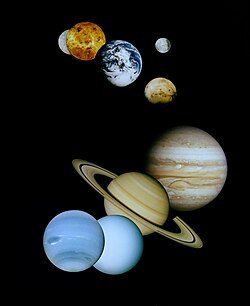
Planets are the most important component of the solar system after the Sun. A planet is any body that revolves around the central star of its planetary system and is large enough to assume a spherical shape due to its own gravity and clear its orbit of other similar bodies. In our system, there are two types of planets: rocky and gaseous. The rocky planets are Mercury, Venus, Earth, and Mars. They are composed of metal cores surrounded by a solid rock surface. The gaseous planets are Jupiter, Saturn, Uranus, and Neptune. They are much larger than the rocky planets and are composed of relatively small rocky cores surrounded by gigantic gaseous atmospheres.
Satellites are bodies that orbit planets and are some of the most interesting objects in the solar system. We call them moons or natural satellites (to distinguish them from objects we've sent into orbit around other celestial bodies), and we can find them orbiting most planets, as well as Kuiper Belt objects and asteroids. Some satellites are even larger than the planet Mercury and have atmospheres and strong winds. Gas giants have a large number of satellites, some so small they were only discovered when we sent space probes to study the planets up close.
Scientists created the category of dwarf planets to describe Ceres, Pluto, and other similar objects recently discovered. Dwarf planets are celestial bodies that orbit the Sun and have a spherical shape but are not large enough to be considered planets. Currently, five dwarf planets are known: Ceres, Pluto, Eris, Haumea, and Makemake, but they are difficult to study due to their small size and the great distances that separate us from them. Only Ceres and Pluto have been observed in detail by space probes sent to study them.